Hercule Poirot
The Murder of Roger AckroydHercule Poirot, living quietly in King's Abbot under the name Mr. Porrott, is drawn out of retirement to investigate Roger Ackroyd’s murder. His decisive contribution is not simply to identify the murderer, but to test the apparently coherent case against Ralph Paton against overlooked discrepancies, reconstructing the crime from evidence that implicates the trusted narrator, Dr. James Sheppard.
Identity and Arrival
Poirot is a private detective who, according to Flora Ackroyd, retired a year before the murder investigation and moved to King's Abbot to live without being bothered. The village initially knows him as a foreign stranger, Mr. Porrott, and has little information about him beyond his interest in growing vegetable marrows. His misleadingly ordinary public profile prompts Dr. Sheppard to joke that he must have been a retired hairdresser because of his moustache.
The gap between Poirot’s reputation and his chosen anonymity is quickly exposed. When Flora recognizes him as the celebrated detective, she explains that Roger Ackroyd knew who he was and had promised to keep his identity secret. Poirot’s quiet retirement is therefore not ignorance or obscurity: it is a deliberately protected privacy, undone when the murder makes his skills useful to Flora.
The Village and the Investigation
King's Abbot is a small community whose social life is organized around local knowledge and gossip. It has a large railway station, a small post office, and two rival general stores; able-bodied men often leave, while unmarried women and retired military officers are prominent. The village’s two important houses are King's Paddock, left to Mrs. Ferrars by her late husband, and Fernly Park, Roger Ackroyd’s home. In this setting, Poirot arrives as an object of speculation before he becomes an investigator.
Flora asks him plainly to find the murderer, fearing that the police are on their way to make a mistake. Poirot observes that the police will conduct their own inquiry, but agrees to assist when Flora insists that they may be wrong. The request sets his investigation against the danger of premature certainty: Inspector Davis has already assembled a persuasive account that makes Ralph Paton the obvious suspect.
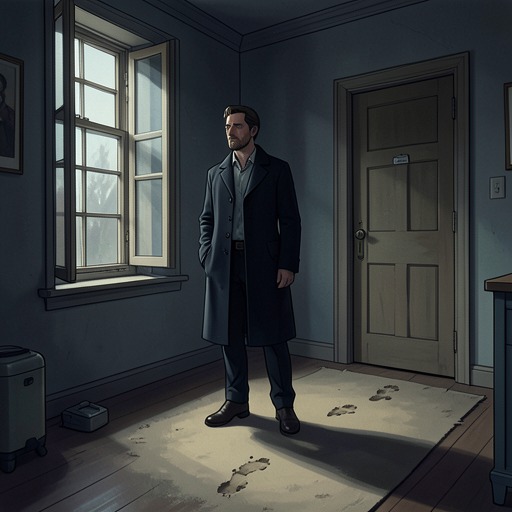
That account draws on specific circumstances. Paton left just before nine, was reportedly seen near Fernly Park around half past nine, had serious money difficulties, and has not been seen since. A pair of his nearly identical rubber-studded shoes is available for comparison with the prints near the house. Davis then imagines Paton leaving by the window, taking the murder dagger from the silver table, returning to the study, and escaping after the killing. Poirot does not accept a story merely because its sequence appears to fit; his later reconstruction shows why a plausible timeline must still be tested against the evidence and its sources.
Method and Evidence
Poirot’s method combines attention to material clues with scrutiny of testimony. When considering how the study could have appeared secured, he allows for a mechanical device, such as a time lock or an alarm clock, but notes that this possibility narrows the field to someone who knew about Ackroyd’s dictaphone and possessed the necessary mechanical knowledge. Rather than treat the apparent locked-room problem as proof of an impossible crime, he asks what knowledge and opportunity the supposed mechanism would require.
The window footprints receive the same careful treatment. Poirot lays out three possibilities: they may have been made by Paton, who had been at Fernly that night; by someone else with the same kind of shoe studs; or through a different explanation. He rejects the coincidence that an outsider happened to wear the same sort of shoes, noting that the household’s shoes had crepe-rubber soles and that Charles Kent’s boots were in very poor condition. This is a process of elimination, not a single clue treated as conclusive.
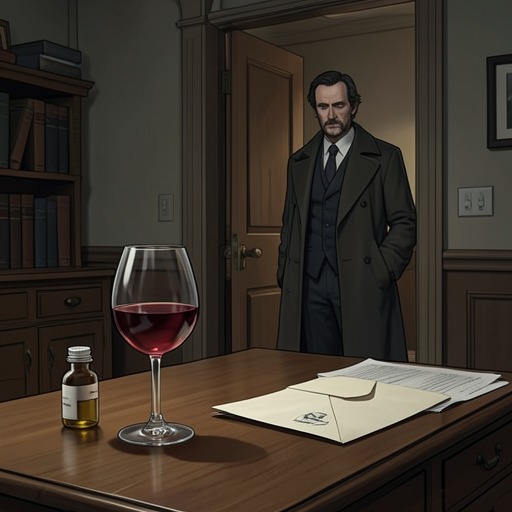
He also considers who could have obtained the dagger. Flora was certain that it was missing from the silver display table when she examined it, so the killer must have had the opportunity to take it before her arrival. By the final recapitulation, Poirot has combined this timing with a set of other constraints: the murderer had been at the Three Boars earlier that day, knew Ackroyd well enough to know of the dictaphone, had mechanical ability, could take the dagger before Flora arrived, had a suitable receptacle such as a black bag for the dictaphone, and had a few minutes alone in the study after the crime was discovered while Parker telephoned the police. The force of the conclusion lies in the combined pattern of access, knowledge, and opportunity.
Poirot’s attention to time proves especially important. Everyone, including Sheppard, agrees that the walk from the lodge to the house takes five minutes, or less by the shortcut to the terrace. Yet Sheppard says he left the house at ten minutes to nine and, by his own account and Parker’s, passed through the lodge gates at nine. The unexplained ten-minute interval becomes a clue. Poirot also recognizes that the claim that the study window was fastened rests only on Sheppard’s statement: Ackroyd had asked whether the doctor had secured it, but had not checked for himself. This exposes how an apparently settled fact can be only a witness’s assertion.
Investigation Beyond the Obvious Suspect
Poirot’s inquiry ranges beyond the police’s focus on Paton. When Parker’s garbled account of blackmail surfaces, Sheppard says that Parker must have been listening at the door and presents himself as ready to tell the police everything. Poirot later tests Parker’s possible access to conversations by staging an experiment with Flora: he asks for her help in reconstructing Parker’s actions and checking whether voices in the lobby could be heard from the terrace. The experiment reflects Poirot’s practice of turning an uncertain claim into a question that can be examined.
He also understands how village rumor can distort an investigation. Colonel Carter repeats that he has heard blackmail mentioned and confidently supposes a woman is involved, but this is speculation rather than proof. For Poirot, local talk can point toward questions worth asking while remaining distinct from verified evidence. His presence appeals to Caroline Sheppard precisely because a detective’s investigation gives village curiosity a more consequential object than everyday gossip.
Poirot’s inquiry into Paton leads him to challenge the assumption that the missing man is simply at large. He reasons that if Sheppard is hiding the young man, the concealment must be nearby. A hotel is unlikely, and lodgings less so; a nursing home for the mentally unfit offers a more plausible place to look. Poirot tests this theory by inventing a nephew with mental trouble and asking Caroline for the names of suitable homes near Cranchester. She gives him two homes to which her brother has sent patients. At one, Poirot discovers that Sheppard himself brought in a patient early on Saturday morning; under another name, the patient is identified as Paton. After the necessary formalities, Poirot brings him away, and Paton arrives at Poirot’s house in the early hours of the following morning. This discovery establishes both that Paton was concealed and that Sheppard had helped conceal him.
Exposure and Narrative Significance
At the final gathering, Poirot tells those present that his list is one of suspected persons and that everyone there had the opportunity to kill Ackroyd. Mrs. Ackroyd reacts with alarm, but Poirot insists that she remain to hear his account. The collective scrutiny matters: instead of allowing suspicion to settle on the missing Paton, Poirot makes the assembled household confront the fact that opportunity was widely shared and that the apparent solution is not enough.
Poirot then names Dr. Sheppard. Sheppard laughs and calls him mad; Poirot remains calm and identifies the discrepancy in time as the point that first drew his attention. He uses the ten-minute walk against Sheppard’s five-minute estimate, alongside the unsupported claim about the study window, to show how the doctor’s own account creates the opening for the crime. The conclusion overturns the trust placed in the investigating physician: Sheppard has not merely misread the clues but has used his position and narration to shape what others, including the reader, believe.
The disclosure redefines Poirot’s role in the story. He is both the retired outsider who arrives in a village where everyone wants to know everyone else’s business and the investigator who distinguishes knowledge from rumor, testimony from fact, and a neat explanation from a tested one. His final reasoning depends not on one spectacular revelation but on the accumulation of small inconsistencies: a mistaken name, a missing dagger, questioned footprints, a concealed patient, and, above all, time that does not add up.